Osterlander Volkszeitung, July 14, 2023
Electric buses are now also rolling through Gera
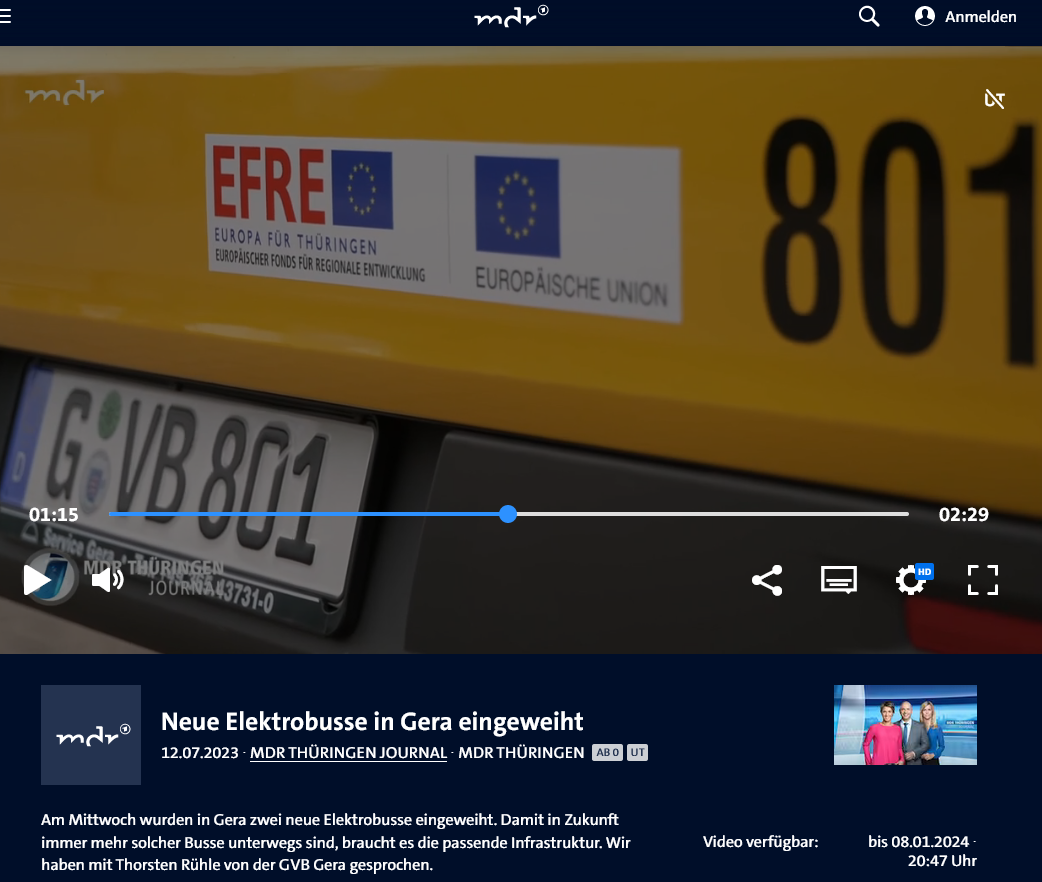
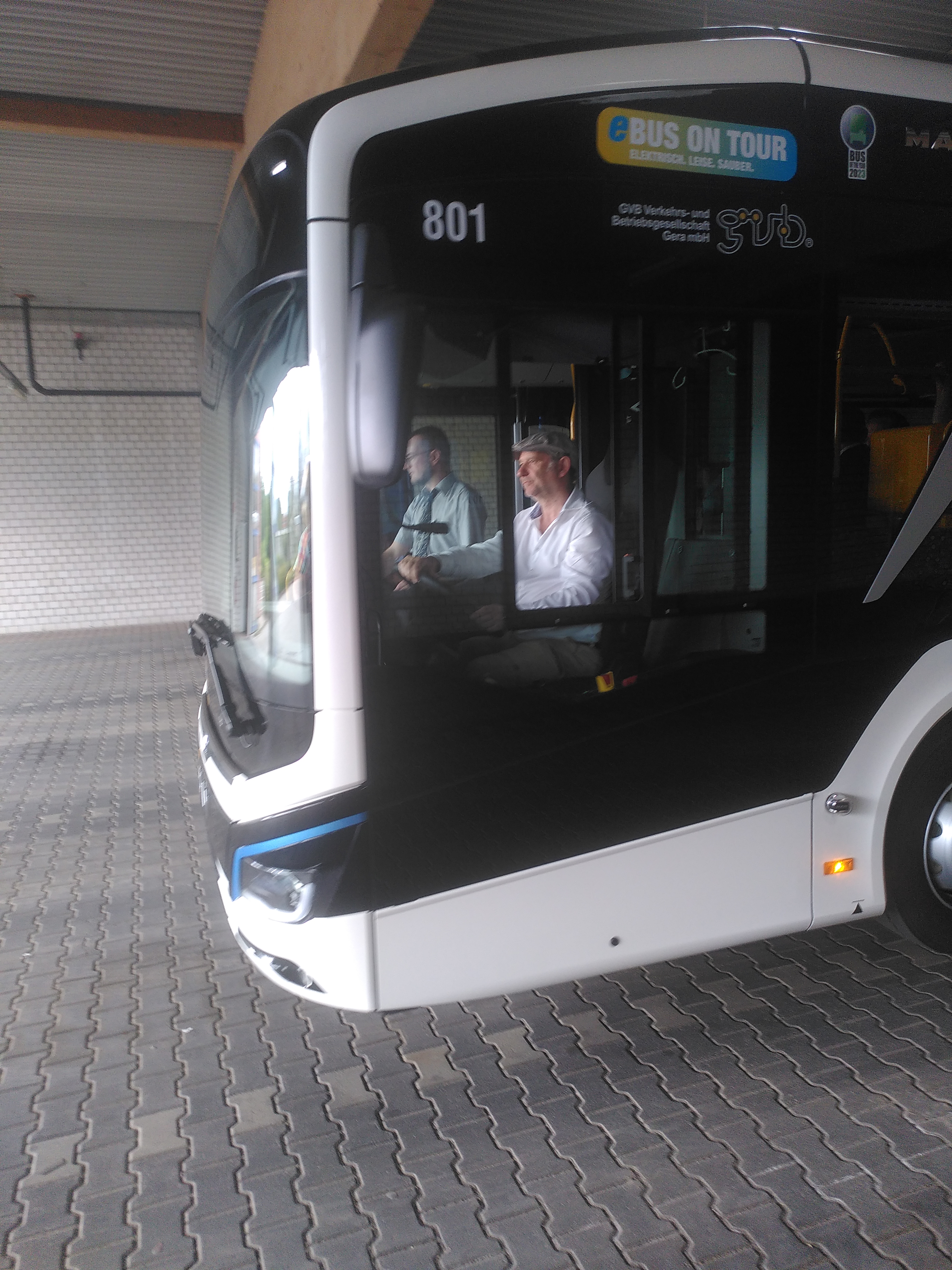
GVB Verkehrs- und Betriebsgesellschaft Gera mbH (GVB) is beginning the electrification of its bus fleet. MAN Truck & Bus Deutschland GmbH was awarded the contract for the first two Lion's City 12c E solo buses last year following a Europe-wide tender. The decision to procure electric buses was preceded by a feasibility study, commissioned in November 2020 from the Fraunhofer Institute Dresden in cooperation with EBF Innovation GmbH and completed in May 2021. The feasibility study examined various technical solutions and technologies for the deployment of emission-free buses for GVB, taking local conditions into account. This included considering the use of electric buses with different charging models as well as fuel cell buses. As a result, GVB received a recommendation and a concept for the phased conversion of its bus fleet to battery-powered buses that will be charged exclusively at the depot. With the expansion of electromobility in the city, GVB is taking another important step towards sustainable and environmentally friendly mobility. The new buses are not only emission-free but also equipped with the latest generation of high-performance batteries. They are characterized by high energy efficiency and a range of at least 240 kilometers, which MAN guarantees even after seven years of operation. This makes them well-suited for shorter routes in urban traffic without the need for recharging. "The purchase of these new electric buses was only made possible by the attractive funding program of the Thuringian Ministry for the Environment, Energy and Nature Conservation, which, with subsidies covering 75 percent of the costs for the buses and 80 percent for the charging infrastructure, made the conversion to emission-free bus services possible for GVB and thus for the city of Gera in the first place. E-buses currently cost slightly more than twice as much as comparable diesel buses," explains GVB Managing Director Thorsten Rühle. “The level of funding provided by the Ministry of the Environment using ERDF funds is exemplary; however, given the current prices for e-mobility, we are dependent on such high levels of funding to ensure the investment remains economically viable and fares affordable,” Rühle continued. The Thuringian Ministry of the Environment is subsidizing the fleet conversion through a model funding program from the European Regional Development Fund. “Clean, quiet, climate-friendly – I am delighted that Gera has now also opted for the e-bus fleet. Electric buses are now reliably operating throughout Thuringia. Passengers and transport companies are consistently satisfied. Many drivers are looking forward to their shifts with electric propulsion.”Residents living near the bus stops are also strong supporters of quieter acceleration and reduced particulate matter pollution – especially on busy days. We will support public transport during the transition to
“We will continue to support emission-free propulsion,” promised Environment Minister Bernhard Stengele. Over the past few months, GVB (Graz Public Transport) has upgraded its depot to install the necessary charging infrastructure. Six wired 120 kW fast-charging stations are now available in the bus garage to charge the recently acquired vehicles as well as the next four electric buses planned for purchase. A bus battery can be fully charged in just four hours. To provide the necessary electrical power for the chargers, a new transformer station with a 10 kV medium-voltage connection was also installed at the GVB depot, connecting to the existing GVB substation, which was upgraded accordingly. The electric buses are charged exclusively with green electricity. Meanwhile, the transport company has also invested time in training bus drivers and technical staff. In addition to operation and driving techniques, training covered topics such as the relationship between driving behavior, topography, and weather conditions, which have a significant impact on battery charge and thus range. of the e-buses. “Mobility is one of the central issues of our time. But the last few years have taught us that we need to rethink mobility. The switch to new, emission-free drive technologies is an important step on this path, which public transport in Gera is now also taking. This makes public transport in our city an even more sustainable service that not only reliably gets people in Gera from A to B, but also contributes to protecting our climate and thus our own personal environment,” explained Mayor Julian Vonarb. For the next few years, GVB plans to purchase another four electric buses to gradually replace the aging diesel buses with sustainable and environmentally friendly buses.
The Thuringian Ministry of the Environment is funding buses and technology in Gera with around €1.5 million from the "Model Project Electric Bus Systems" funding program. This will put electric buses number 30 and 31 into operation in Thuringian public transport.
Currently, there are 31 electric buses operating throughout Thuringia (29 of which are subsidized by the Thuringian Ministry for the Environment, Energy and Nature Conservation (TMUEN), including the two new ones in Gera). These are located in the district of Nordhausen (7), Jena (5), Heilbad Heiligenstadt (4), Bad Langensalza (4 in total, 2 of which are subsidized by TMUEN), Suhl/Zella-Mehlis (3), Eisenach (2), Gera (2), and Ilmenau (2 automated vehicles/“People Mover”). More are expected to follow this year: Public transport companies in Bad Salzungen (2) and Bad Langensalza (1 more) are also continuing to invest in new technology. In Weimar, the transport company, with funding from TMUEN, is currently operating the first hydrogen buses (3) in Thuringian public transport. Since 2018, TMUEN has invested approximately €22 million in the subsidization of electric buses. In the new ERDF funding period until 2027, approximately €34 million will be available for buses, local trains and the respective charging and refueling infrastructure.